
You Know Modern Yachts. Now Sail Something Different
Adam’s Introduction
Before I started Classic Sailing, I used to sail on yachts at events like Cork Week and made many English Channel crossings. All the courses I completed to become an RYA Yachtmaster Instructor were on modern yachts. So, I know both ways of sailing and hope I can explain what makes traditional sailing for yacht sailors so different and why you might like it.
Your sailing experience gives you a head start
Your knowledge will stand you in good stead. The terminology will be familiar, you know what to expect on the water and how to handle yourself. Port and starboard, bow and stern are all terms from way back in your learning.
The principles are familiar, but the methods differ
The sails still need hoisting, setting, lowering and, lastly, stowing properly. The parts may have different names and the tasks may be described in old-fashioned ways, but the important bit for you is that you will understand the purpose. Where the wind comes from and what it does to the boat is no surprise. Spotting the differences is all part of the fun.

You become part of a larger sailing team
Generally speaking, more people are required to carry out tasks, and they are more spread out around the deck. The team will be led by experienced crew to begin with, but with your experience, you can quickly prove you are capable of leading a team on your own if you so wish.
There is more direct sail handling
Your sailing is not cockpit-centred. You go to the sail-handling stations rather than having everything led back aft. In fact, this is one of the big differences.
Modern cockpits are comfortable and sociable, but their inward-facing seating can draw some attention into the boat. Traditional sailing places you around the deck, looking outwards towards the sails, sea, weather and coastline. For me, that creates a stronger connection with the natural world. One of my favourite duties on a larger tall ship is being one of the duty lookouts. See our article on spotting wildlife.
The addition of more sails adds to the interest. You may have three or more headsails and four or five up the mast. It all requires greater coordination. A straightforward manoeuvre, such as tacking, becomes a sequence of tasks shared across the vessel. Rather than operating a line from the cockpit, you work as part of a coordinated sailing crew. The manoeuvre may take longer and involve more stages, but that shared process is an important part of traditional sailing.
Instead of the familiar “Ready about, lee-oh”, you may hear a sequence of commands such as: “Hands to tacking stations. Ready about. Helm’s a-lee. Let fly the head sheets. Mainsail haul. Let go and haul.” Each command starts another carefully timed part of the manoeuvre, carried out by teams stationed around the ship. The exact terms vary according to the vessel’s rig, local expressions and the captain’s preferences.
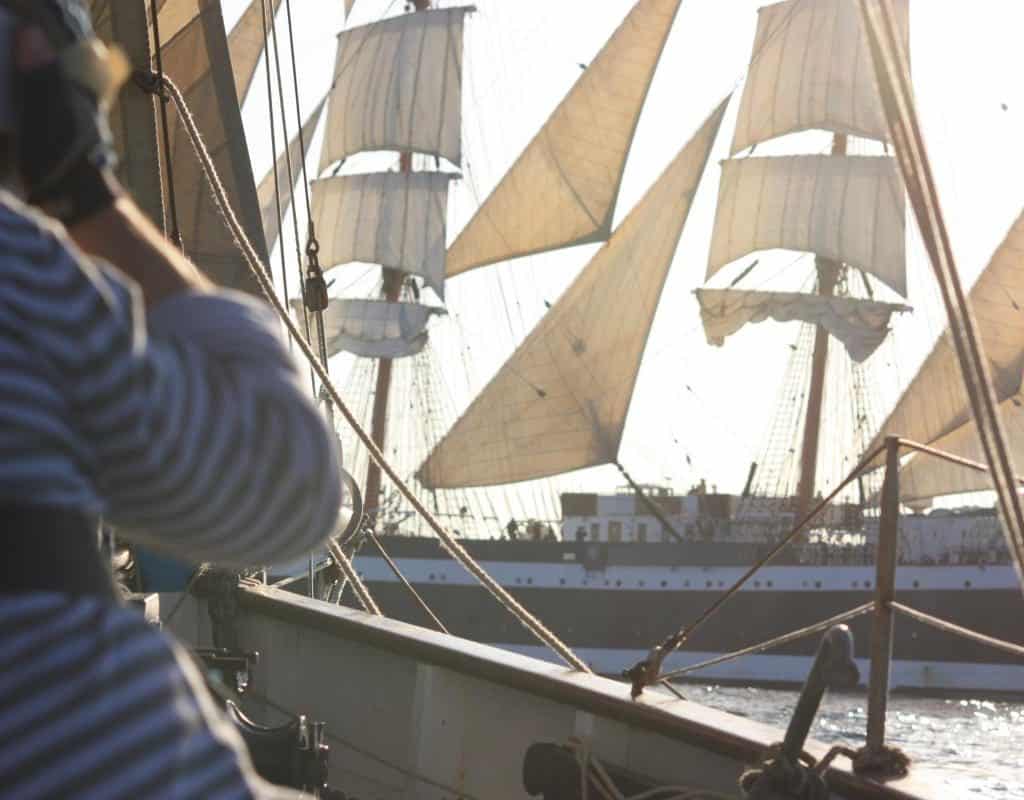
The vessel has a different character under sail
Modern yachts are generally lighter for their size, so changes can happen quickly. With us, turning and accelerating are slower. You have to adjust your helm to take account of the extra turning momentum, which lingers longer before the power of the sails gets you going in the direction you want. On the other hand, our weight allows us to ride more comfortably through the waves.
You will not sail as close to the wind as you are used to, so it is important to understand that we are not a modern racing machine. Study the rig and you can begin to learn why and where modern sails grew from. Yes, we do race amongst ourselves, and that can be very exciting, but it is not our main reason for sailing.
Good sailing requires anticipation
This is true for any age of sailing, but for us, we need to allow more time to prepare for a manoeuvre and for it to happen. It may need to be done in a hurry, but rather than relying mainly on winches, we rely on teamwork, encouraging a team experience.

Different rigs broaden your understanding
Ever wondered why old ships have more sails, bowsprits and the like? A lot of it is to do with the technology of canvas and the weight of the structure. If you can only go upwards using wood and shrouds, you quickly reach an unstable state. So, instead, you go out at the front and the back. Look at the sails we use. They are all supported by either wire or wood, and they are a combination of smaller sails that create a large sail area. Canvas made from cotton or linen tends to stretch. That means the way the sails are supported and set has to allow for that stretch.
Life aboard bigger ships is more like a community
The bigger the ship, the more crew there are. You are able to sail across oceans and enjoy remote expeditions. You will be split into watches, and there will be more specialists on board. Deckhands, bosuns, cooks, engineers and ships’ officers all go together to make a small village sailing across the water. Accommodation can vary from cabins for two or four people to more communal spaces. Of course, all our vessels have modern toilets and hygiene facilities.
Traditional sailing still uses modern safety systems
GPS, AIS, radar, liferafts and firefighting equipment are all carried on board as required. Taking care of life is paramount in all we do. All our vessels are certified and operated under the appropriate national maritime authority.
Safety also extends to how people are treated aboard. As a Community Interest Company, Classic Sailing has policies to safeguard crew and voyage participants from abuse, harassment and harmful behaviour. Everyone should be able to take part in a safe and respectful environment.
It adds another dimension to your sailing
As you know, sailing keeps you on your toes. The sea and its conditions are endlessly variable. Tall ships and traditional vessels come in many sizes and have lots of different rigs. You never stop learning about the sea aboard any sailing vessel. Traditional sailing simply adds another range of vessels, skills and experiences to explore.
Is Traditional Sailing Right for a Yacht Sailor?
Traditional sailing is not simply modern yacht sailing with older-looking sails. Manoeuvres can take longer, accommodation may be more communal and there may be fewer labour-saving systems. Those differences will not suit everyone. For many sailors, though, they provide the greater involvement, teamwork and sense of purpose they have been looking for.
8–14-night voyages you might enjoy
Longer voyages of more than 14 nights

Do my yacht-sailing skills transfer to a traditional vessel?
Yes. Your understanding of wind, sail trim, navigation and general seamanship will give you a strong starting point. The rig, commands and working methods may differ, but the underlying principles of sailing remain familiar.
What is different about traditional sailing for yacht sailors?
Sail handling is usually more spread out around the vessel and involves more people. Manoeuvres may require several carefully timed stages rather than controls operated from the cockpit. Traditional vessels also tend to respond more slowly and require greater anticipation.
Do I need experience of traditional vessels before joining?
No. The professional crew will explain the vessel, safety procedures and your role aboard. Previous yacht experience should help you learn quickly, but you do not need experience of gaff, lug or square rigs before joining.
See our related article ‘Learning to sail traditional vessels’


