
A frequent question I get asked is “Do you actually get to sail the ship, I don’t want to sit there just watching?”
The answer is yes. On a traditional tall ship voyage, you are not a passenger. You are part of the crew. That distinction matters more than any brochure language can capture, and it shapes everything about what we do at Classic Sailing.
“The Top to Bottom of Tall Ship Sailing” is a way of describing tall ship sailing. It means understanding the whole ship, from the mast head to the keel at the bottom of the ship, from the foresails to the engine room. Most importantly, it means becoming a working part of the crew that actually sails it.
That is what makes traditional tall ship sailing worth doing. The incomplete picture, wind, sails, standing on deck watching the coast go by, is pleasant enough. But it misses everything that makes the experience genuinely memorable.
On Deck
This is where the work happens, and the work is the point.
From your first day aboard you are handling lines, adjusting sheets, and learning how sail trim changes the way the ship moves through the water. You steer. You stand watch. You work as part of a small team and you begin to read what the wind is doing and why certain things are done in a certain order.
Day One
My first day on a tall ship I was put on the helm straight away as we left the dock wall. Before setting to see all the three watches had been put through short training exercises. As part of the helm training you had to repeat back to the watch officer the command you had been asked to do. So if they said ‘Port 20’ you had to reply ‘Port 20’ and then steer the ship 20 degrees to port by the compass. They asked you to do it in a loud voice so they could hear your answer even in a gale of wind. Because I demonstrated a louder voice than any one else I was chosen to be the first on the helm. That was the qualification. Not experience. Not knowledge. Just a willingness to join in to the best of my ability.
The learning on deck is not complicated in the way that technical sailing can be. It is practical and physical. You understand something when you have done it yourself, not when someone has explained it to you without demonstrating it. You are not studying a manual. You are sailing a ship.

The Bowsprit and Going Aloft
Going out on the bowsprit and climbing aloft into the rig are two things that separate tall ship sailing from any other kind of sailing. Neither is compulsory. But if you can do them, you should, that’s what I always most look forward to doing.
You will not be sent up without training and the proper safety equipment. A good ship runs proper briefings and uses harnesses and jackstays as a matter of routine. Once you have done it once, you will understand why experienced crew members consider time aloft to be one of the best things about sailing a traditional ship.
The view from up the mast, underway, with the ship moving beneath you, is something you will not forget. I once, many moons past, photographed a blue shark from aloft using a telephoto lens on a film camera. You could just make out the outline. I wish I had been using colour film!
What you are doing when you go aloft is not a tourist experience. You are handling real sails on a working ship. That is the historic experience, the one that has not changed in any meaningful way since these vessels were first built centuries ago.

Below Decks
The image of life below decks on a traditional ship tends towards the romantic or the grim. On a modern voyaging vessel, neither applies.
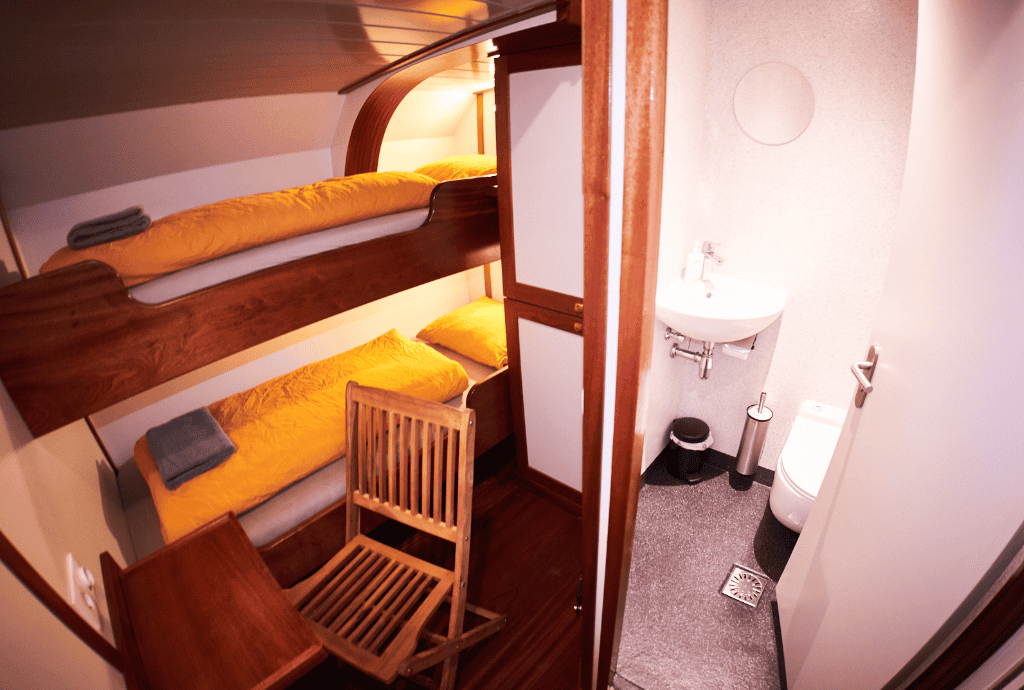
Modern tall ships carry proper berths, good heads, and galleys that produce excellent, well-cooked food. The crew eat together. There is storage, charging points, and enough headroom to move around without permanent crouching. It is not a hotel, and it is not a hardship. It is a practical and comfortable space organised around the job of sailing the ship.
Below decks is not separate from the sailing. It supports it. The cook feeds the watch. The engineers keep the systems running. All our vessels carry engines for manoeuvring in harbour and for passage-making when required. They do not replace the sailing. They make it possible to keep to a schedule and ensure your travel home goes to plan.
Life at Sea
On voyages with overnight passages, life on board settles into routine quickly. Watch systems divide the crew into groups that share the sailing across the day and night. You stand your watch, hand over to the next watch, and sleep. Then you do it again.
This rhythm takes a day or two to feel natural, and then it becomes the shape of the day. You can’t stop a ship overnight in the middle of an ocean. The sea does not stop. The watch system is how a small group of people do get a chance to stop but still keep everything working without running themselves ragged.
You eat together at fixed times. You talk. You share tasks. You get to know the people you are sailing with in a way that does not happen in ordinary life. You don’t go home at the end of the day, the people you work with are the people you socialise with. The ship is your world, and everyone on it is part of the same adventure.

What You Are Actually Learning
It is not zero to hero. If that phrase were applied to traditional sailing, it would set exactly the wrong expectation.
What happens on a voyage of any reasonable length is something more useful than hero status. You arrive knowing nothing, or very little. You follow instructions. You make mistakes and correct them. You begin to see patterns; why sails are set in a particular order, why timing matters when a squall is sighted, why clear communication keeps things calm when things move quickly.
By the end of the voyage you are not an expert. But you are a useful crew member. You understand the ship and your role on it. You know what to do when the watch officer asks something of you, and, importantly, you understand why it needs doing.
We’ve found over 28 years that this shift happens on almost every voyage. The moment when a first-timer stops waiting for instructions and starts getting themselves in the right place by anticipating what’s coming next. It usually happens quietly, somewhere in the middle of a night watch.
A Story Worth Telling
Back along I sailed as watch officer on the Malcolm Miller, a youth sail training ship. We were in the English Channel, heading for the Channel Islands. A gale had started, and a youngster took a fall that left them briefly unconscious. With a serious head injury on our hands, we called for the Alderney Lifeboat to evacuate the casualty ashore.
It was a dark night. The sea was getting rougher. As the lifeboat came alongside to take the injured person, strapped to a floatable stretcher, the decks were brightly lit and the waves were churning between the two ships.
On the helm was a young man we knew was on remand for antisocial behaviour. My job was to supervise him at the wheel. To ensure we held exactly and steadily to the course the lifeboat required. Any deviation could have put the stretcher or the handlers into the sea between the two vessels. All the activity of the transfer was visible from the helm position, and the temptation to look away from the compass was considerable.
The transfer succeeded, not without some close calls and very quick reactions from the lifeboat team due to the waves. The casualty, we later found out, was fine.
After the watch, the youngster told me it was the first time he had understood the need to follow instructions without setting himself against them. Did it change his life? I don’t know. I hope it was a step in the right direction.
That is what tall ship sailing is still capable of. Not “sail training” in the old institutional sense, that phrase is long out of date. But a life-motivating experience that happens naturally, as part of the adventure, with no compulsion and no certificate required.

The Picture Is Never Complete
Part of what makes traditional tall ship sailing worth returning to is that it does not run out.
No two ships are the same. No two passages are the same. The weather is different, the crew is different, the waters are different, and what you notice is different because you yourself are different from the last time. Sail a ketch and then a barque and you will discover that skills transfer, but the ship does not behave in exactly the same way. Working out why is the variety that keeps experienced crew members coming back.
You only stop learning when you step ashore. That is the beauty of it.
For daily tall ship news and voyage updates, follow Classic Sailing on Facebook — over 65,000 sailors already do.
Sailing, Not Cruising
If you are looking for a relaxed cruise where someone else does the work, a traditional tall ship voyage is not the right choice.
These ships exist to be sailed, not admired. The voyages are designed around participation rather than observation. There is no autohelm running overnight while the crew sleeps. There is no AI managing the sail plan. Steering is done by hand, at the wheel, with the compass in front of you and a wake you can see. Sails are handled by people hauling on lines. The ship goes where the crew takes it.
That is what traditional sailing means, and it is why the experience of sailing one of these vessels is unlike anything available on a modern yacht or a cruise ship.
The work is real. The sailing is real. The sense of achievement at the end of a passage is something you have actually earned.
Current Tall Ship Sailing Voyages
We are particularly excited about our short break and taster voyages this season, they are the ideal starting point for anyone considering tall ship sailing for the first time.
A voyage of two to four days gives you everything: the watch system, overnight passages, time on deck, the option to go aloft, crew meals, and the genuine sense of sailing a working ship. You come back knowing whether you want more. Most people do.
Browse short breaks and taster voyages →
Read our guide to your first tall ship experience →
Frequently Asked Questions
Do I need sailing experience to join a tall ship voyage?
The Top and Bottom of it is no sailing experience is needed on the vast majority of our voyages. We get asked this constantly, usually by people who worry they will hold the crew back or not understand what is going on. In our experience, first-timers are some of the best crew members, precisely because they come without habits to unlearn.
The ships are crewed by professional officers and experienced hands who have trained hundreds of first-timers. You will be shown what to do, in real time, on the actual ship. The learning is immediate and practical. Within a day, most people are genuinely useful on deck.
If you want to work towards a formal qualification, RYA training opportunities are available on selected vessels. But apart from those voyages there is no requirement and no test. You are there to take part, and taking part is exactly what is expected.
Will I be treated as an adult on board?
Yes. This comes up more often than you might expect, and we feel strongly about it.
Traditional tall ship sailing attracts people who have done many things in their lives. They are not looking for a managed experience with a safety briefing at every turn. They want to be given a job, trusted to do it, and left to get on with it. That is how good ships run. The watch officer gives the instruction. The team carries it out. You are trusted to do so.
We provide voyages on vessels where this approach is standard. If a ship felt otherwise to us, it would not be in our programme.
What is the food like on board?
Better than most people expect, that’s what we hear from sailors returning from their first voyage.
Galleys on modern tall ships are professional kitchens run by experienced cooks. The food is cooked fresh, served at the table, and eaten together as a crew. On longer voyages you can expect proper meals twice a day with snacks and hot drinks available around the watch system. The quantity is generally generous. Sailing is physical work and crews are hungry.
Dietary requirements, vegetarian, vegan, and most common allergies, can be accommodated on almost all our vessels. It is worth confirming at the time of booking.
Can I actually help sail the ship, or is it mostly watching?
This is the question that matters most, and the answer is: yes, you sail the ship.
From your first watch you will be on the lines, on the helm, and learning how the sails work in real conditions. You do not need to know anything in advance. The professional crew will show you what to do. The point of the voyage is that you take part, you are not an observer.
Going aloft and out on the bowsprit are optional, but both are offered on most of our traditional square-rigger voyages. First-time sailors are regularly surprised by what they accomplish. Climbing to the top yard arm on day three is not unusual.
Read: How it feels on your first sailing trip →
What if I get seasick?
Seasickness is real and there is no point pretending otherwise. Most people who are going to feel it do so in the first day or two, and the majority recover well once acclimatised to the motion of the ship.
Our advice: take medication preventively if you have any history of seasickness. Stay on deck in fresh air if you feel unwell. Keep eating small amounts. Being useful on deck is usually the best remedy, being below you lose sight of the horizon. Of course you may need to go below to keep warm or sleep, that is understood.
Seasickness does not disqualify you from tall ship sailing. It is part of the experience for many people, and most crew members continue through it. The ships sail on regardless.
How fit do I need to be?
Tall ship sailing is physical work, but it does not require exceptional fitness. You are climbing ladders and hauling on lines, not running marathons. Most people in reasonable health for their age are perfectly capable.
Going aloft requires the ability to climb the ratlines on the shrouds, a bit like a ladder strong but slightly flexible. Once at a yard arm you will be clipped on via your safety harness and you begin to move carefully in the rigging setting or handing the sails. If you have any concerns about this, speak to us before booking. We can advise on which vessels suit different levels of ability, and we are always direct about what a particular voyage involves.
Our sailors are largely in their forties, fifties, and sixties, many of whom had not done anything like this before. The ships are designed to be crewed by people, not athletes.
How long should my first voyage be?
In our experience, three to five days is ideal for a first voyage. Long enough to settle into sailing and experience life onboard overnight. Short enough that if it is not quite what you expected, you have not over-committed.
Our short break and taster voyages are specifically designed for first-timers. They give you the full experience, sail hoisting and handing, rope work, steering, there may be an option to go aloft, crew meals, the genuine sense of sailing a working ship in a way that fits around your working life.
If you want more after a taster voyage, the longer routes are waiting for you.
Browse short break and taster voyages →
Start Your Tall Ship Voyage
In nearly 30 years of booking traditional sailing voyages, we have watched people arrive uncertain and leave having done something they didn’t know they were capable of. That counts.
The ships are real, the crew life is real, and no experience is required. Just a willingness to turn up, take on a job, and see where it takes you.
We’d love to help you find the right voyage. We are a small team and talking sailing is what we do.
Look at all the tall ship sailing voyages →


