
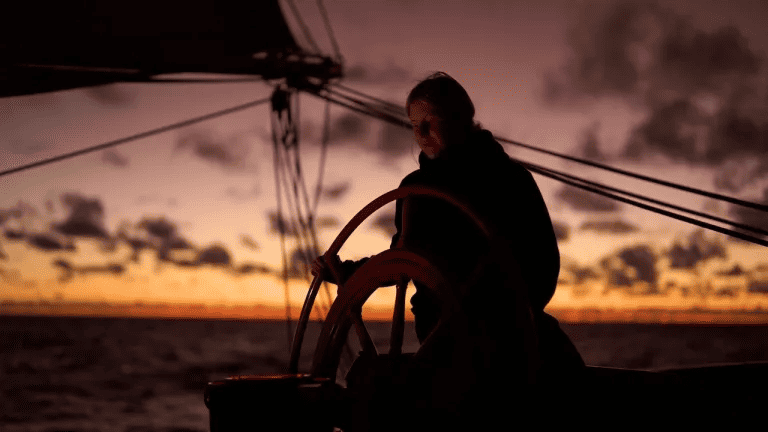
When you take the helm of a tall ship at night, you still have a wheel or tiller in your hands and a compass to guide you. Once you’re settled on course, a star ahead can give you something to steer by between compass checks.
During the day, the decks are often busy. At night, it’s quieter. Two-thirds of the crew may be snug in their bunks, and it’s just you and your watch on deck. Then it’s your turn to take the helm.
Modern navigation and safety systems are on board. On a hands-on Classic Sailing voyage, you’ll also get the chance to steer by hand.
“Everything I learned during the night passage home, the camaraderie of the crew, and the exceptional leadership of skipper and mate made the voyage so special. I came home with new skills, happy memories and a wonderful sense of having shared a magical adventure.”
Tamsin, Tallulah

Keeping a compass course after dark
The compass is your main guide, just as it is by day. The person in charge of the watch will give you a course to steer. Once you’ve settled on it, look ahead. On a clear night, you may find something you can use as a reference.
If you’re new to the helm, start with how to steer with a ship’s wheel or tiller. If you’re wondering how the watch keeps a lookout after dark, see Sailing at Night: Common Questions for Beginners.
Steering by the stars
It sounds technical, as though you might need a sextant. You don’t. Once the ship is on course, look up. If you can see the stars or planets, pick one ahead and notice where it sits in relation to the bow. Check the compass regularly to make sure you’re still on course.
If the moon is up, you might see it line up with part of the rigging. You can use that as a reference, too. The moon and stars move across the sky, so keep checking the compass and pick a new reference when you need one.
Steer by Shooting Stars
Not really. Shooting stars are a different matter. I remember coming back from the Isles of Scilly in mid-August during the Perseids shooting star period . No moon and no light pollution. We were spotting shooting stars at nearly 30 an hour.
“So many highlights, but sailing at night with sparkling dolphins at the bow was truly breathtaking!”
Sue, Morgenster
Steering by the sails
Sometimes you’ll be asked to steer so the sails stay filled. But how can you tell if they’re full at night? Once your eyes have adjusted to the dark, you may find you can see them. Sometimes the crew will shine a torch on the sails, taking care to preserve your night vision.
Unless you’re deaf like me, you can also hear when the sails start to flutter or flap. A little flutter is a hint. A loud flap is not good, hope you don’t wake the captain. (They will know anyhow!)
Steering by fixed navigation lights
In coastal waters, the person in charge of the watch may point out a fixed light for you to steer towards. Some lighthouses show different colours depending on where you are. A coloured sector can warn of a danger.
You may also be asked to steer between port- and starboard-hand buoys. If you’d like to understand what the lights and marks mean, you can learn more on an RYA navigation theory course.

What a night watch feels like
Some night watches are quiet enough to count shooting stars. Others take rather more concentration, as Frank found aboard Oosterschelde in the Tasman Sea.
“As a relative novice sailor compared to the more experienced sailors, I found one or two days when the night watches coincided with these rough conditions challenging to maintain a footing.”
Frank, Oosterschelde
Even so, Frank gave us five stars.
You’ll usually sail at night on longer voyages, and every ocean crossing includes night sailing. For more about life on deck after dark, read Embracing the Night: The Unseen Joys of Overnight Sailing.
If you’d like a short voyage with some night sailing, email the Classic Sailing team and we’ll help you find one.
More about sailing at night
Night passage in the shipping lane
Navigating the Night – Sailing on Ocean Voyages
An Introduction to Night Sailing
The unseen joys of overnight sailing
Sailing at Night: Common Questions for Beginners
Ask a Skipper

