

Hi Sailor,
Jessie here,
2025 was the first year in my adult life that I haven’t been sailing. I find this quite a depressing thing to admit. The unstoppable force of a glorious but demanding toddler and fairly major sleep deprivation have made it thus. I miss going to sea with a tangible physicality; I can taste the salt in the air; I can feel the deck move under my feet.
They say absence makes the heart grow fonder, and I certainly think absence has given me a new perspective. What is it that I miss? Why do we love traditional sailing so much?
The Boats
One of the fundamental principles at Classic Sailing HQ is that we only work with boats with bowsprits. There will inevitably be exceptions to prove this rule, but this philosophy keeps us to traditionally rigged ships.
It’s hard to pinpoint exactly why traditional rigging is more lovable. Our aesthetic preferences often tend to favour old-fashioned things. Some kind of nostalgic bias for the workmanship and utility of yesteryear. Let’s face it these boats are beautiful.
There is definitely also a case to be made for block-and-tackle, winch-free sailing being more hands-on and therefore more absorbing. This is a large part of why Classic Sailing prefers traditional ships. We’re not about efficiency. We’re about getting involved (more on this later).
The romantic in us can’t help but personify the ship beneath our feet. Whether or not you adhere to the historic feminine ship-gendering tradition, it’s hard to deny that a ship has character of some sort or other.


Ships Become Yours
Ships you’ve sailed before become like old friends. Their relationship with you is not quite like their relationship with anyone else. You might watch their current exploits from afar with a certain pride (and perhaps a smidge of jealousy), and experience a low level but persistent nagging that you really should catch up with them soon, ‘face-to-face’.
Stepping aboard a new ship can be as heady as an early romance. You forget yourself a bit… (how do I tie a bowline again?! How embarrassing…). You have to learn their strengths and weaknesses, and certain idiosyncrasies that you initially find endearing may, after a long stretch at sea, become irritations.
The process of ‘learning the ropes’ is not just about the transferable principles of sail control and handling. You also need to learn afresh, on every new ship, how the pin-rails are arranged, how the lines lead through the rig and along the deck, the quirks of how the boat tacks and gibes.
Sailing ships are complex beasts, and there is immense satisfaction in getting to know them. Whether you are on board for a weekend or a month, you leave with a greater understanding of, and a real connection to, the boat you’ve sailed. This is one of the reasons why traditional sailing is so engaging. No two ships are the same, and they all have strong personalities.
The Work
I’ve touched on this already, but it’s really important, so I’m going to bang on about it some more! Hard work is really good for us. Especially hard physical work. Especially hard physical work outside. Especially hard physical work outside, as part of a team, with a tangible common goal.

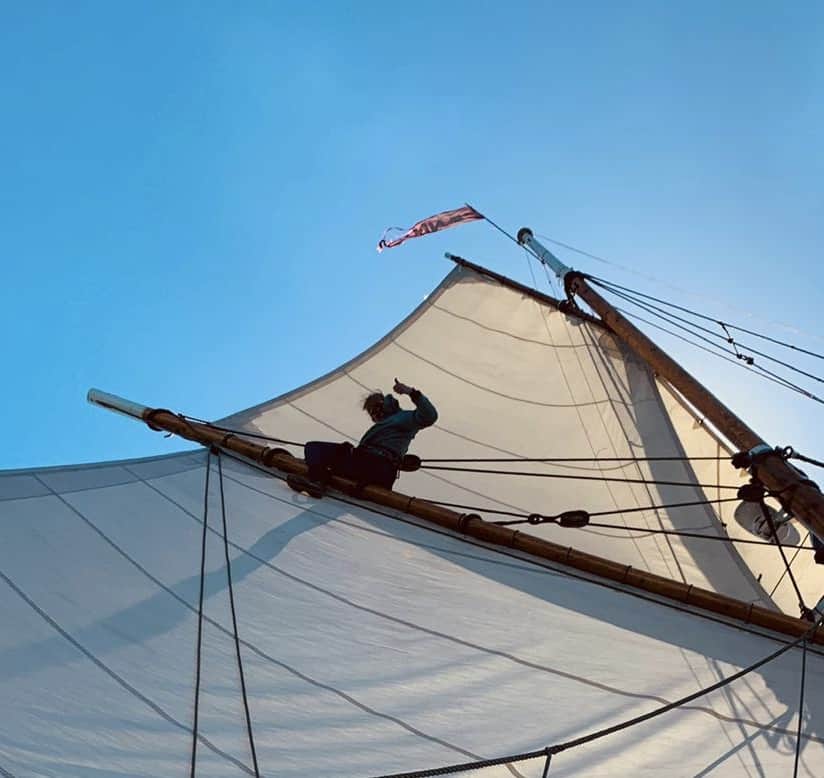
What counts as ‘hard physical work’ for you will vary hugely depending on your specific circumstances, but there are countless roles on deck and there are always opportunities for you to push yourself. That might be climbing to the t’gallants to stow sails, it might be helping to haul a line, or it might be helming.
All the while, the ship is moving beneath you. You are constantly adjusting to keep yourself upright. On an ocean passage you’ll be working even as you sleep, gently tensing to avoid falling out of your bunk (sadly the subconscious isn’t always aware of the lee-cloth you’ve rigged to avoid this calamity!).
Going to the heads is work. Putting on your boots is work. Getting a cup of tea is work (on a choppy day it’s even more work getting the tea up on deck, still in its mug). It’s exhausting.
So why is it so good?! Partly because it’s exhausting, I think. We don’t experience much of that these days, sat in front of screens and watching world events unfold at a distance. Our brains are frazzled but our bodies are lethargic. Feeling physically tired can be refreshing. Combined with all that sea air you sleep the sleep of the righteous.
It’s also very real and immediate. Goals are small (Have a wee. Get your boots on. Make tea) but achieving them feels good because it’s hard work. Plus it’s funny. And you’re sharing the experience of working so hard with a bunch of other people, who are also thrilled to have had a wee, to have their boots on and to have a cup of tea.
Type Two Fun
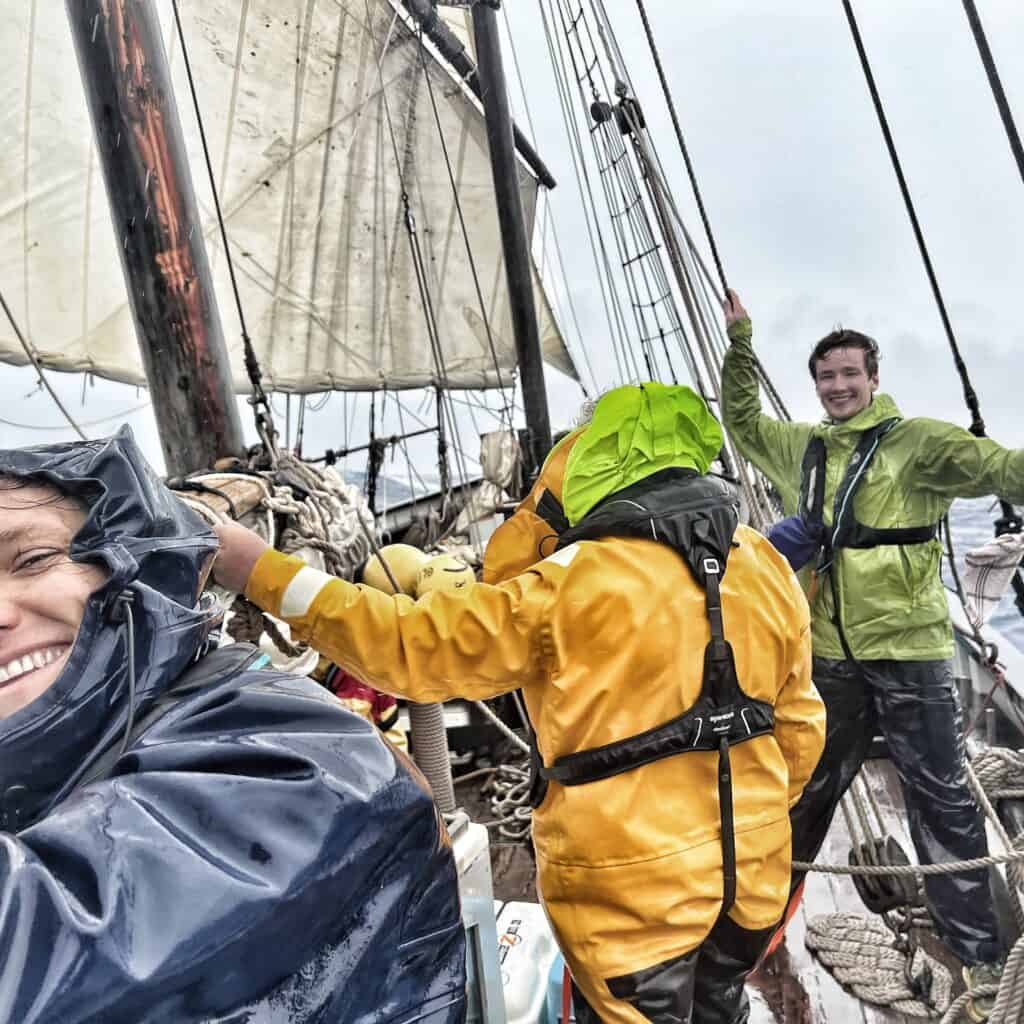
When things aren’t so immediately pleasurable, and perhaps when you have to work the hardest, is when the weather turns tricky, there’s an emergency or a breakage. Then it’s all hands to the pumps, metaphorically speaking (…hopefully).
Somehow, though, even these situations become immensely rewarding in hindsight. Through your hard work, and that of your crew mates, the situation is resolved, the storm weathered, repairs made. And a new category of enjoyment is entered into. These are the realms of Type Two Fun, the cornerstone of conversation in seaside pubs the world over.


The Wild
Something else we don’t get much of these days is wilderness. A sense of space. The humility that comes from feeling incredibly small.
Given how far and wide we have spread our influence as a species, it’s amazing there’s anywhere left in which we can feel unimportant. In reality, of course, human impact on the oceans is terrifying, wide-ranging and potentially catastrophic… but this is hard to see while sailing across a sea that has looked the same for centuries.
This is not about escaping the burden of our environmental responsibility. Quite the opposite. This is about regaining and reinforcing our respect for things outside of us. It’s easy to fall into the trap of assuming humanity is all-powerful, all-important and in control. That’s a very dangerous place to be. We all need a regular dose of being put in our place by wilderness.
You don’t need to sail far from land to get that feeling. Big sky. Big sea. Not a lot else. The curiosity of marine mammals over your presence in their world only adds to the sense that you are somewhere other.
Ironically, being made to feel insignificant in the face of nature only imbues us with a greater impetus to act on its behalf. You’d be hard pressed to come back from a traditional sailing holiday without a renewed allegiance to, and desire to protect, the ‘wild’.
We’re All Wild
On a personal level, getting out into the weather reconnects us to our own wildness. We are animals. Yes, we think too much and talk too much and construct all sorts of stuff around ourselves to keep the big bad world out. But fundamentally we are animals and we need basic things to survive. Water (or tea!), food, sleep, companionship, staying warm and somewhat dry.
Achieving these simple things whilst out on the wild wet sea feels GOOD, and we get some perspective back on what’s actually important in our own day-to-day lives.


The People
Finally, it’s you lot. Of course. Traditional sailing is quite unlike any other kind of holiday in this regard. You’re not chartering a whole boat with your nearest and dearest (you can, of course, but it’s not the norm), often as not you’re travelling to join a ship on your tod. Over two thirds of Classic Sailing sailors travel solo. That’s a big commitment of time and money for a holiday where you’ll be trapped in close confines with a bunch of people you’ve never met before.
I LOVE this about you. It gives me hope for humanity. Because it’s an optimistic thing to do. You’re assuming the people on board are going to be decent, likeable, folk who you can both work alongside and have a good time with. And the funny thing is…. they are.
Here’s the bit I really love. You don’t get on with your fellow crewmates because they’re just like you. They aren’t. These trips and these ships attract a wide variety of people- all ages, all stages of life, all political persuasions, all backgrounds.
You all get on because you’re working together for a common goal, in the fresh air, and you’re all just people. Talk might turn to politics or current affairs once in a while, and you might realise your perspective is different, but you also realise that it doesn’t matter.


There is no greater antidote to the echo-chamber of our social media / newspaper choices / media viewing. It’s so important to realise that we can all rub along together, despite some fairly major differences of opinion. And not just rub along together, but have a laugh, support each other and sail a bloody tall ship!
There are barriers to some people coming sailing of course, most notably financial but also cultural, psychological and practical ones. We’ll have exciting news for you soon on this score… because we’re keen to bring traditional sailing to as broad an audience as possible. Not only will it be good for those who haven’t tried it yet, but fresh faces and new perspectives are also good for those of us already here. Variety is the spice of life, and a diverse crew is the strongest, happiest one.
I Think We Might Be On To Something…
Come rain or shine, hell or highwater, pilot cutter or square rigger, type one or type two fun, fairweather sailing or blowing a hoolie, we just love it.
Sleep deprivation or not, I need to get back out there. Hopefully see you on deck soon.
What do you love about traditional sailing? Let us know!…. we read every message and we’d love to hear from you.
All the best,
Jessie
Frequently Asked Questions
What makes traditional sailing different from modern sailing?
Traditional sailing uses historically rigged ships with bowsprits, relying on block-and-tackle systems rather than modern winches. This makes sailing more hands-on and physically engaging. The boats themselves have strong individual personalities, and learning each ship’s unique characteristics – how lines are arranged, how she tacks and gibes – is part of the experience. It’s not about efficiency; it’s about getting deeply involved with the work of sailing.
Do I need sailing experience to join a traditional sailing voyage?
Most traditional sailing voyages welcome complete beginners alongside experienced sailors. The crew works together to sail the ship, with everyone learning the ropes – both literally and figuratively. Whether you’re climbing to the t’gallants or hauling lines, there are roles on deck for all abilities, and you’ll leave with a real understanding of and connection to the boat you’ve sailed.
Why is traditional sailing considered good for you?
Traditional sailing combines hard physical work outdoors with teamwork toward a common goal. It reconnects you with simple, immediate challenges – everything from putting on boots to making tea becomes work on a moving deck. This physical exhaustion, combined with sea air, provides refreshing contrast to screen-based modern life. Being in wilderness conditions also gives perspective, making you feel appropriately small in the face of nature while reinforcing environmental responsibility.
What kind of people go traditional sailing?
Over two thirds of Classic Sailing sailors travel solo, joining crews of people from all ages, backgrounds, and walks of life. Traditional sailing attracts a remarkably diverse mix of people who get along not because they’re similar, but because they’re working together in the fresh air toward a common goal. It’s an optimistic choice – committing time and money to a holiday with strangers in close quarters – and it consistently proves that people from very different perspectives can work together, support each other, and sail a tall ship successfully.
What is Type Two Fun in sailing?
Type Two Fun refers to experiences that are challenging or even unpleasant while happening, but become immensely rewarding in hindsight – the cornerstone of conversation in seaside pubs worldwide. When weather turns tricky or equipment breaks, it’s all hands working together to resolve the situation. Through hard work and crew cooperation, storms are weathered and repairs made, creating the kind of satisfying stories and bonds that define traditional sailing adventures.
Contact Classic Sailing: WhatsApp: +44 1326 459 053 Phone: +44 1326 531 234
For daily tall ship news and voyage updates, follow Classic Sailing on Facebook — over 64,000 sailors already do.
facebook.com/ClassicSailing


